


Paramedic
Paramedic Program Overview
The School of EMS is proud to say the Paramedic Course has a pass rate of 82.5%, a retention rate of 83.9%, and positive placement rate of 97.1% for the year of 2024. These numbers represent 798 SOE graduates becoming nationally registered paramedics and entering the workforce! SOE continues our growth nationwide while maintaining our high expectations and exceeding national standards.
The paramedic level is the highest pre-hospital certification obtainable. Paramedics practice the art and science of pre-hospital medicine in conjunction with medical direction. Paramedics are an essential component of the continuum of care and serve as links in the chain of various health resources. The emerging roles and responsibilities of the paramedic include public education, health promotion, participation in injury and illness prevention programs, and functioning as a facilitator of access to care as well as an initial treatment provider. Applicants must be a current EMT prior to admission to the paramedic program.
The School Of EMS Paramedic program is accredited by the Commission on Accreditation of Allied Health Education Programs (www.caahep.org) upon the recommendation of the Committee on Accreditation of Educational Programs for the Emergency Medical Services Professions (CoAEMSP).
Commission on Accreditation of Allied Health Education Programs 727-210-2350 www.caahep.org
To contact CoAEMSP: 214-703-8445 www.coaemsp.org
Please note that a high school diploma or GED as well as a state ID or driver’s license is required. All students must pass a drug screen as well as a background screening.
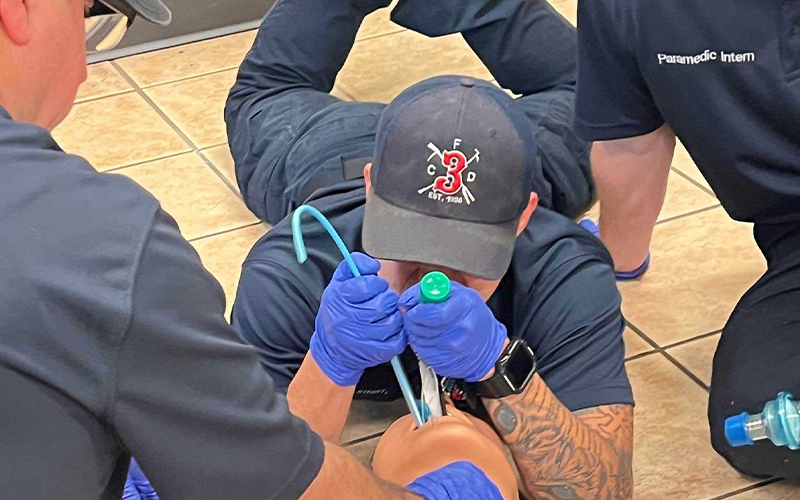
Program Highlights
- Program completed in weekly modules with an assigned Primary Instructor and teacher assistant dedicated to you and your classmates.
- Lectures Pre-recorded for unlimited viewing.
- Access to education team via several formats for educational assistance.
- Bi-Weekly Non-mandatory live review sessions with Q/A opportunities
- Access to all Live Q/A sessions with instructors within all programs.
- Field Internship: 288-396 hours
- Clinical Experience: 12-120 hours
- *Hybrid options only available in the state of Florida.
What’s Included?
- Educational Platform Access
- NREMT Testing Prep
- ID Badge
- Clinical Scheduling System
- Certification of: AHA BLS, AHA ACLS, NAEMT AMLS, NAEMT PHTLS, and NAEMT EPC
- All State Jurisprudence Certifications or similar requirements
- Background screening
- Drug screening
Contact Us Today
Fill out the form below to sponsor a Paramedic Class near you or click here to email direct.
*For total estimated cost, see the institutional catalog here for more information
Books and uniform not included in cost of program
Paramedic Program FAQs
A paramedic is the highest level of prehospital EMS provider and is trained to deliver advanced emergency medical care, make critical treatment decisions, and serve as an essential link within the healthcare system.
To become a paramedic, you must first obtain EMT certification and then successfully complete an accredited paramedic program. The School of EMS’ Paramedic Program prepares students for National Registry certification and workforce entry.
Yes. Applicants must hold a current EMT certification prior to admission into the School of EMS Paramedic Program.
The School of EMS Paramedic Program is typically about 45 weeks in length, though timelines may vary by region.
School of EMS graduates may have opportunities to pursue academic credit through partner institutions and transfer agreements. Credit acceptance is determined by the receiving college or university.
The primary difference between our Online and Hybrid EMS programs is how the required in-person lab days are scheduled. Both formats include the same total number of lab days, but they are completed differently.
Paramedic Program: Both the Online and Hybrid Paramedic programs require a total of 12 in-person lab days.
- Hybrid Paramedic: Students attend lab sessions every several weeks throughout the program, totaling 12 lab days.
- Online Paramedic: Students complete their 12 lab days across three separate 4-day sessions, held during Weeks 9, 28, and 37. In both the EMT and Paramedic programs, the total number of required lab days remains the same regardless of format. The only difference is how frequently students attend those lab sessions and how the in-person training is scheduled throughout the program.
Paramedic program tuition ranges from $8,750–$9,250, depending on your state and location. Explore available courses in your state for specific pricing.
School of EMS also offers a $500 employer-pay discount.
School of EMS proudly supports military members and veterans. Housing stipend assistance may also be available in certain states through School of EMS and its third-party administrator.
Yes. The School of EMS Paramedic Program is accredited by the Commission on Accreditation of Allied Health Education Programs (CAAHEP) upon the recommendation of CoAEMSP.
The program includes certifications such as AHA BLS, AHA ACLS, NAEMT AMLS, NAEMT PHTLS, and NAEMT EPC, along with required state-specific certifications where applicable.
We do not offer a separate, shortened AEMT-to-Paramedic bridge program; instead, students go through their standard paramedic training program which accepts certified EMTs as the base prerequisite.
School of EMS combines experienced instructors, structured support, live review opportunities, and strong student outcomes. In 2024, the program achieved an 82.5% pass rate, an 83.9% retention rate, and a 97.1% positive placement rate.
Paramedics work in ambulance services, fire departments, hospitals, emergency response organizations, specialty transport services, and other healthcare-related settings.
Paramedic salaries vary based on state, employer, certifications, experience level, and geographic location. A paramedic certification can create opportunities for advancement and increased earning potential within EMS and healthcare systems.
The program includes flexible online instructional components supported by faculty, scheduled coursework, and ongoing academic support. Hybrid options are currently available only in Florida.
School of EMS works with approved clinical and field partners in numerous locations. Clinical placement options vary by state and region. Students should speak with admissions regarding available clinical opportunities in their area before enrollment.
Join School of EMS and take the next step toward a rewarding career as EMT or Paramedic professionals.
