


The Things We Do Not Chart
– By #School of EMS
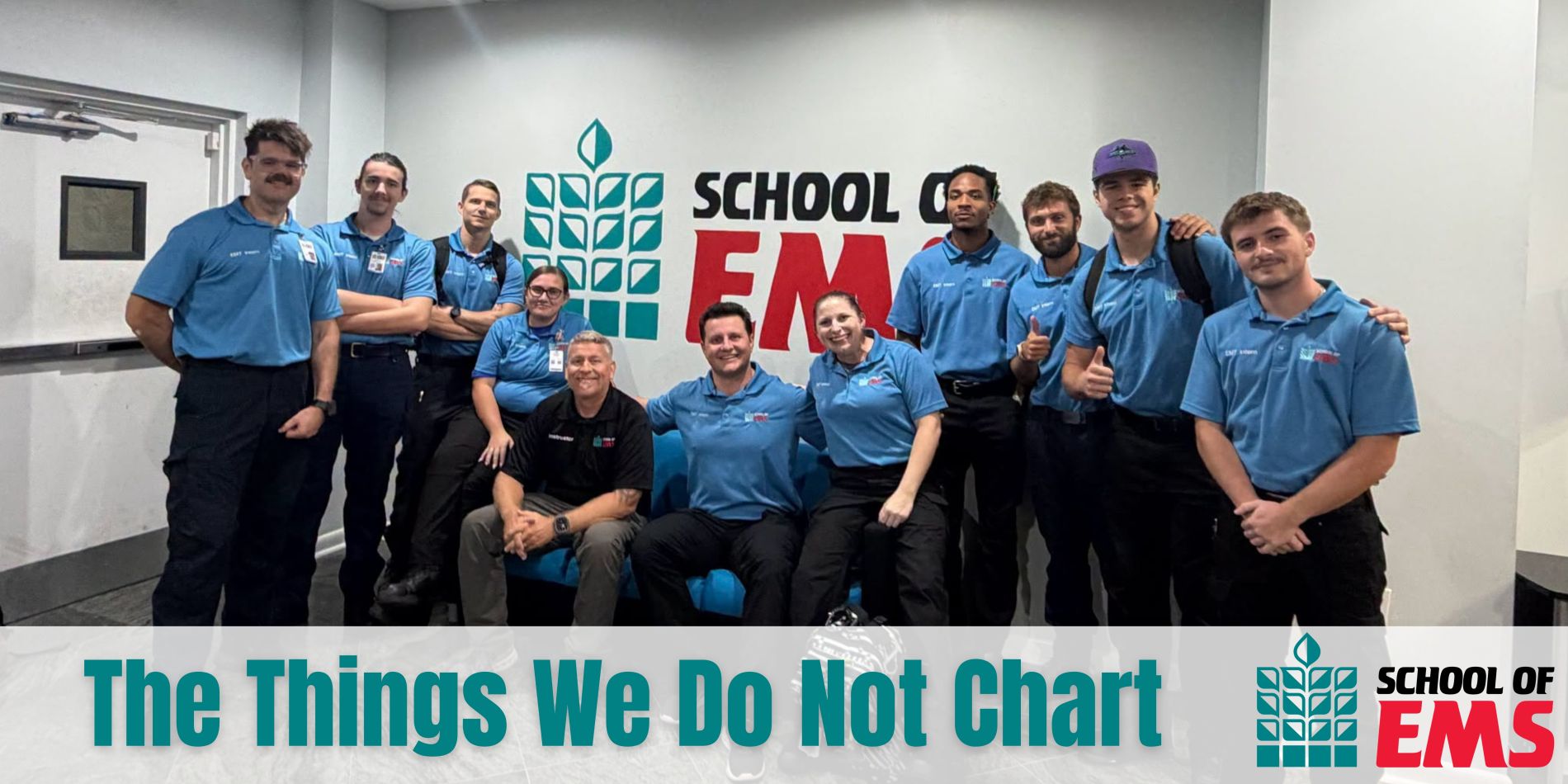
School of EMS' Chad Pate reminds us that some of the most meaningful parts of patient care never make it into the documentation. While clinical skills save lives, small acts of empathy, patience, and compassion, from easing a patient's fears to making sure their dog is safe, can make all the difference. The message is simple: great EMS providers care not only for the emergency, but for the whole person behind it.
There is no checkbox for making sure the dog won’t get out.
You are standing in someone’s living room. The stretcher is ready. Your partner is waiting. And the person who needs to go to the hospital keeps looking past you toward the front door.
“The dog,” they say. “Please don’t let him out.”
To you, it might be one more detail to handle.
To them, it might be the one thing keeping them from agreeing to leave.
So, you close the door. Check the latch. Tell them again that the dog is safe.
Then you go.
Later, you document the assessment, the treatment, the transport.
The dog probably doesn’t make it into the report.
But that moment belongs to the care you gave.
We teach students to recognize what matters.
A change in mental status. An abnormal respiratory effort. A finding that changes the next decision.
That work demands knowledge, discipline, and practice. Patients deserve clinicians who know what they’re doing.
They also deserve clinicians who notice when their glasses are still on the kitchen table.
Who explain what’s happening before moving them.
Who cover them before opening the door to a hallway full of strangers.
Who hear “I don’t want to go” and become curious about why.
Sometimes the answer is fear. Sometimes it is money. Sometimes it is a spouse who cannot be left alone.
Sometimes it is the dog.
A person’s emergency arrives with the rest of their life attached. We don’t get to choose which parts come with them.
There is a particular kind of power in entering someone’s home wearing a uniform.
People may trust you before they know your name. They may tell you something they have never told their family. They may let you take charge because they are frightened, exhausted, or simply out of options.
That trust can make it easy to move too quickly.
We know the sequence. We know where the equipment goes. We know what happens next.
The patient may know none of those things.
Imagine lying on your own floor while strangers discuss you in a language you only partly understand.
Imagine hearing laughter from across the room and wondering whether it is about you.
Imagine being called “the fall” while you are still trying to tell someone your name.
Familiarity helps us function in difficult situations. It can also dull our attention to how those situations feel from the other side of the stretcher.
We have to keep noticing.

At the School of EMS, that responsibility reaches beyond the people providing care.
An instructor models it when a student gets something wrong and still feels safe enough to ask another question.
A staff member practices it when someone says, “I’m confused,” and gets a patient explanation.
A leader reinforces it by paying attention to how people are treated when the schedule is crowded and everyone is tired.
Students learn from the way we teach. They also learn from the way we treat them.
If we want future clinicians to preserve dignity under pressure, they need to experience what that looks like here.
Think about the clinician you would want walking into your parents’ home.
You would want them to be capable. Thorough. Ready to recognize a serious problem and act.
And while your parent searched for a hearing aid or asked the same question again, you would want that clinician to remain patient.
You would want them to understand that the person on the stretcher has a whole life you know and love.
Every patient has that life, whether someone is there to explain it or not.
The next time you finish a call, a class, or a difficult conversation, consider one question:
What did I do that helped this person feel less alone?
There may be no dramatic answer.
You found the glasses.
You explained the next step.
You gave someone a moment to gather themselves.
You made sure the dog wouldn’t get out.
Some of the most meaningful things we do are small enough to disappear from the paperwork.
Let’s make sure they don’t disappear from the care.
______________________________________________________________________________________________________________________
 - Written by Chad Pate | Director of Operations and Innovation, School of EMS
Last Modified: